
Subtotal
$0.00
Resonance and the Cosmic Vision
For Indian contemporary artist Sourajata Kumar, art is neither decorative nor purely aesthetic—it is the theater of creation itself, where cosmic energy takes visible form. Educated at the Government College of Art, Kolkata, under the University of Calcutta, Kumar began his artistic journey in the late 1980s with a disciplined study of still life, watercolor, and life drawing. He recalls the long path to acceptance at one of India’s most competitive art institutions as his first lesson in persistence and patience—qualities that later defined his career.
Influenced by the muscular forms of Michelangelo and the vibrant surrealism of Salvador Dalí, Kumar’s early paintings reflected both physical intensity and mystical energy. Over time, his practice evolved into what he describes as “a fathomless presentation of cosmic resonance and dynamism.” He believes the entire cosmos is woven with vibration and memory, and that art serves as the vessel through which these invisible energies are revealed. “The universe,” he explains, “is fabricated of resonance—what we perceive through our parallel vision reflects that cosmic energy within us.”
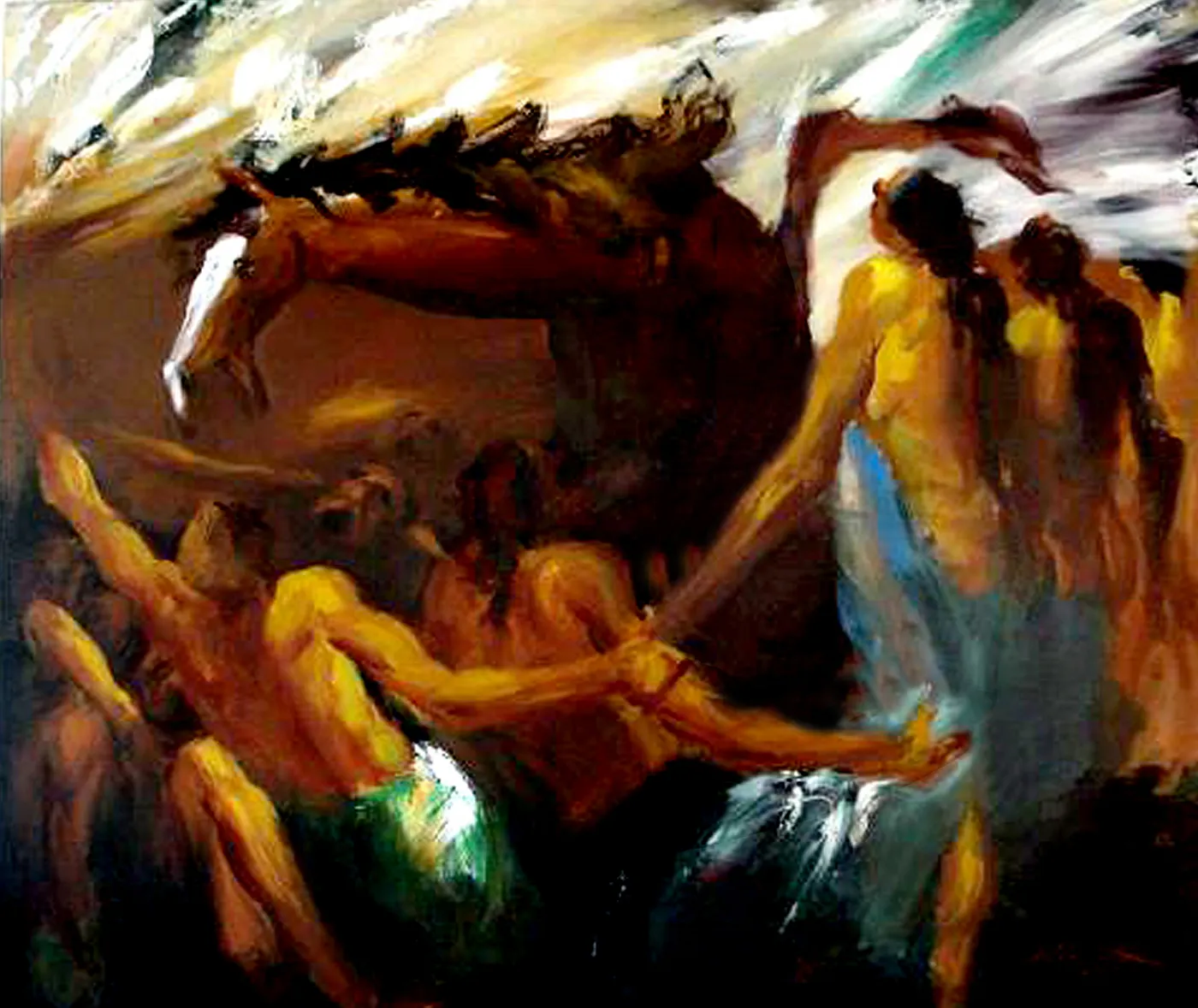
Kumar’s work stands apart for its bold theatricality. His compositions often feature intense lighting, multiple perspectives, and bold black and grey outlines, creating a sense of visual drama and movement. The forms he paints—muscular, charged, and illuminated—mirror his conviction that energy, not sorrow, is the essence of existence. “I have never painted sorrows,” he notes, “as I believe it distributes nothing but a heavy mind.” In each painting, brightness replaces melancholy, and vitality becomes a spiritual offering.
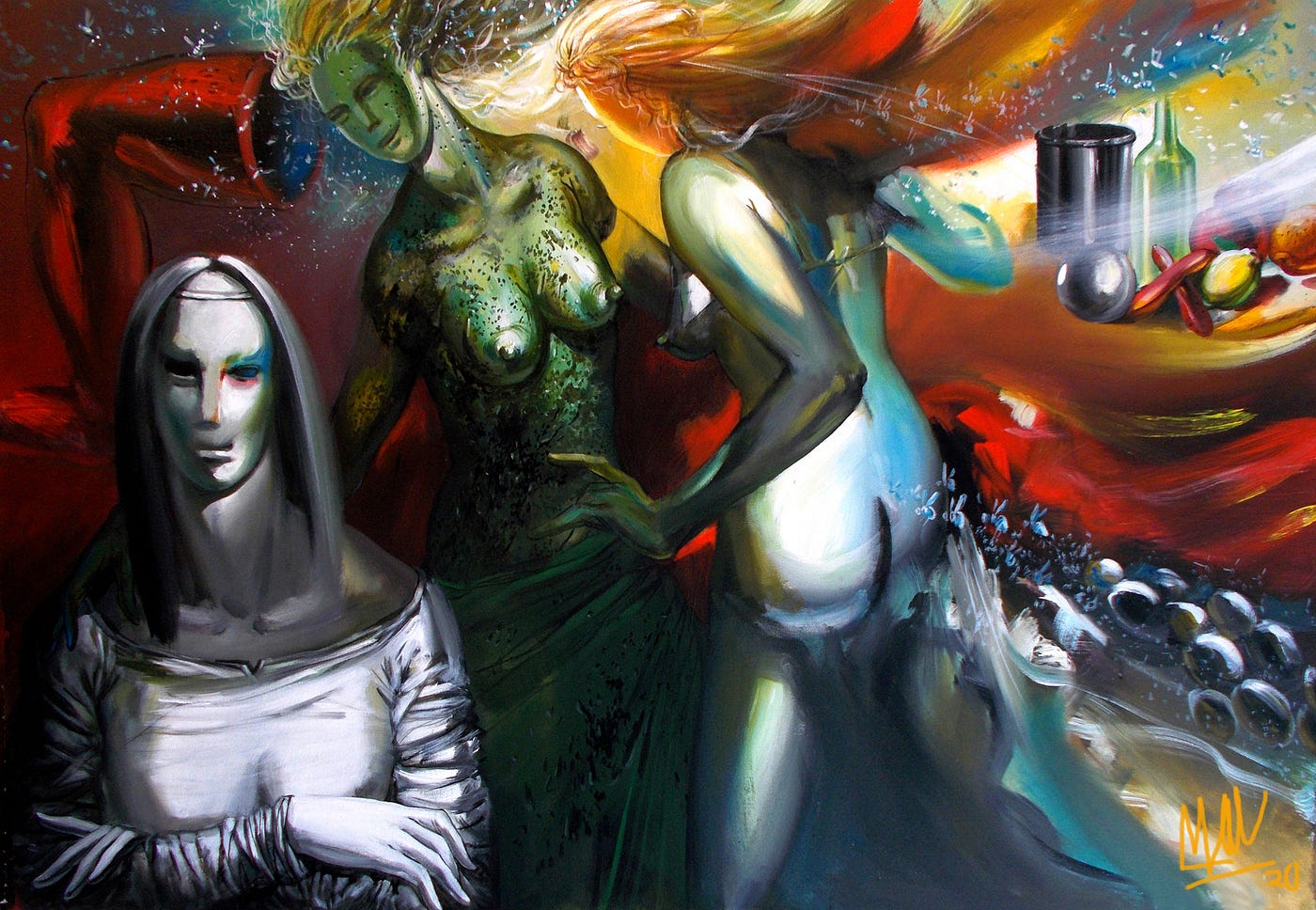
Three Graces from Sourajata Kumar.
The Birth of ED Painting: Innovation and Ecology
By 2012, after two decades of exhibitions and experimentation across media, Kumar found himself frustrated by conventional art materials. The surfaces available in the market, he felt, lacked the strength and sensitivity necessary to capture his ideas. “I went restless and annoyed,” he admits, “because no available medium could truly hold my thought.” This dissatisfaction drove him to invent ED Painting, a groundbreaking technique that uses recycled paper pulp and waste material to create sculptural, three-dimensional surfaces.
ED Painting was not merely a technical solution; it was a philosophical breakthrough. Using concave and convex layers of paper pulp, Kumar achieves the illusion of curvature and depth, producing surfaces that blur the boundary between painting and sculpture. “This medium,” he explains, “is singular in the world art domain. It can replace canvas and stone entirely—eco-friendly, affordable, and enduring.” His innovation represents a marriage of sustainability and spirituality: the transformation of discarded materials into vessels of light and form.
The ecological dimension of ED Painting reflects Kumar’s belief that art and nature are inseparable. “We live in nature, and we are part of it,” he says. “If nature becomes extinct, we shall be extinct too.” Through his process, waste is redeemed, and destruction becomes creation. Each recycled surface becomes a metaphor for rebirth—a theme deeply rooted in his understanding of the cosmos as a continuous cycle of transformation.

WAR WHL from Sourajata Kumar.
Art as Theatre and Total Expression
Kumar’s body of work reveals a restless curiosity and an unwillingness to confine himself to a single form or discipline. Alongside his painting, he has explored metal sculpture, ceramics, wood, puppetry, fashion design, textile work, photography, and digital art. “I consider myself a totalist in the arena of art,” he declares. This “total art” philosophy unites diverse mediums under a single vision: that all forms of creation are extensions of the same cosmic energy.
The theatricality of Kumar’s work emerges not only through composition but also through intention. He constructs scenes illuminated by multiple light sources, transforming each painting into a performance. Figures appear to emerge from darkness, as if summoned by a universal pulse. These dynamic spaces, infused with movement and resonance, reflect his conviction that the world itself is dramatic—a stage where energy continually shapes and reshapes energy.
His approach also resists despair. Rather than depicting tragedy or sorrow, he channels vitality, optimism, and cosmic balance. “Dream and dream and dream,” he insists. “Never should you let it go. Hammer and hammer again on the same wall of failure—no matter how strong it might be, it will break one day. And that day you will succeed like a newborn sun.” For Kumar, perseverance is not a human trait but a cosmic law: every failure refines energy, and every struggle prepares the artist for a greater awakening.

MUSSIC META from Sourajata Kumar.
Engaging with Contemporary Challenges
While Kumar’s recent focus lies in Music and Cosmology, his earlier paintings often addressed social and historical themes such as civil war, barbaric heroism, and human struggle. Today, however, he allows music to guide his imagination. “It is music and the cosmology hidden in music that influence my recent works,” he explains. Through rhythm and resonance, he explores the harmony that underlies chaos—the invisible vibration that sustains all life.
This shift from overtly social subjects to metaphysical ones does not signal disengagement. Instead, Kumar regards art as an enduring mirror of society. “Throughout history,” he reflects, “art has always taken a pivotal role in portraying the events of civilization. What we know as history is substantially the art and culture of a country.” To him, the artist’s task is not to document events but to translate them into the language of feeling and energy, ensuring that what is transient becomes timeless.
At the same time, Kumar warns against the corruption of artistic sincerity by political opportunism. “The very filthy form of politics,” he argues, “should always be discarded—by both the government and common people. My vision is to reject this form through my art.” In his view, artistic freedom is inseparable from moral clarity, and the artist’s first responsibility is to remain honest in intention and expression.
Society, Nature, and the Role of the Artist
Kumar sees artists as integral to the evolution of human consciousness. “An artist is the integral part of society,” he emphasizes. “Art and culture are the true reflections of civilization.” This conviction has guided him through decades of creative practice and teaching. For thirteen years, he served as a fine art instructor at a premier English school, nurturing younger generations while pursuing his own exhibitions across Italy, Australia, China, Singapore, the Philippines, Malaysia, and major Indian cities.
The wide international recognition of his work has not distanced him from his roots. His paintings remain grounded in an awareness of nature, rhythm, and human vulnerability. He insists that art must remain unbound—free from institutional and ideological encumbrances. “Art and artists, in whichever field and form, should always be free,” he says. “Freedom is not a luxury; it is the breath of creation itself.”
This understanding of freedom also extends to his ecological practice. By reusing materials and slowing his process, Kumar resists the culture of overproduction and artistic spectacle. His sustainability is not performative but philosophical: to work patiently, to allow materials to breathe, and to let silence become part of the artwork’s language. In this sense, sustainability becomes a meditation on time itself.
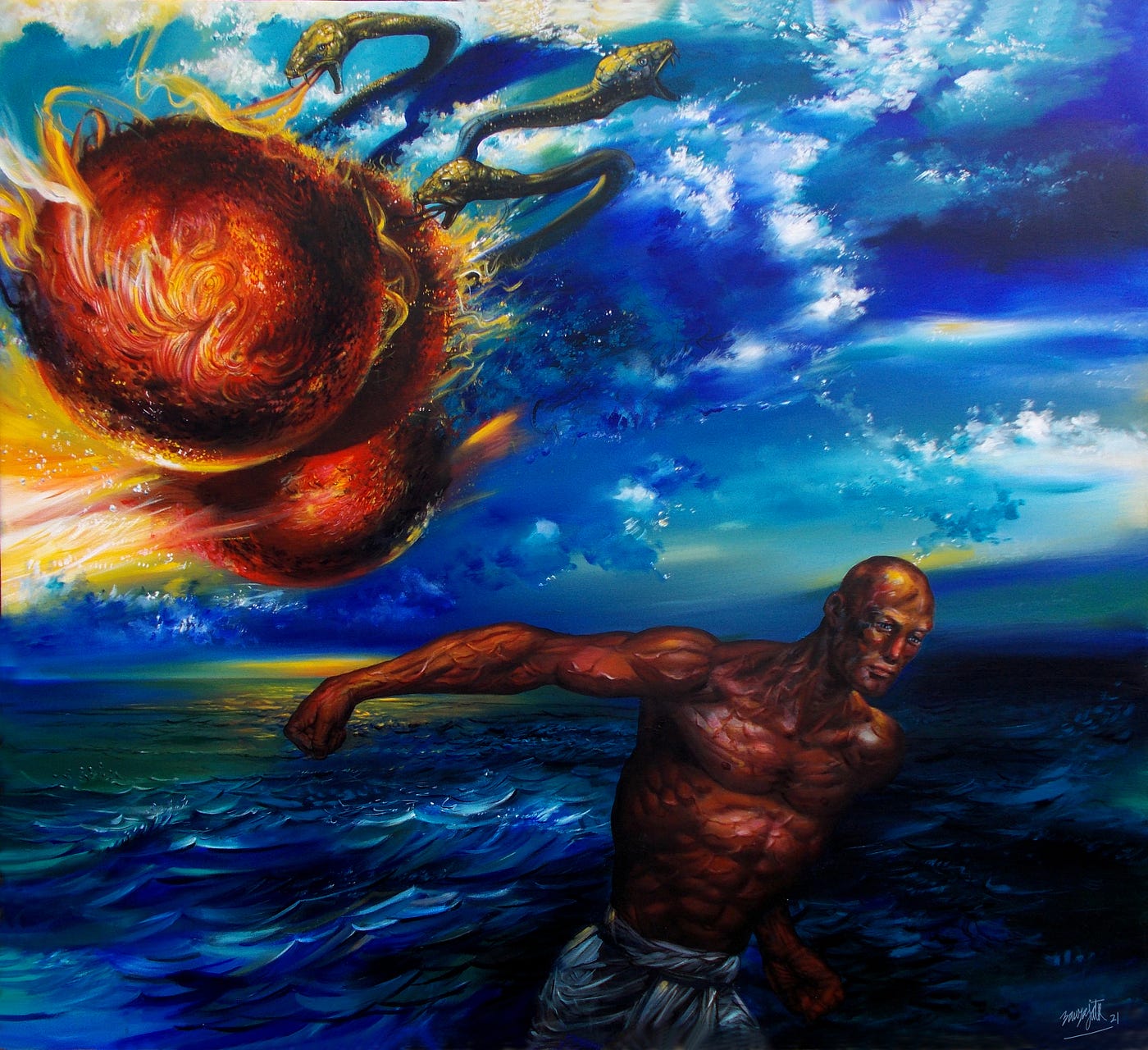
A Historic Sunrise from Sourajata Kumar.
Persistence, Cosmos, and Continuity
Across nearly three decades, Sourajata Kumar has built a practice that bridges innovation and introspection, matter and spirit. His invention of ED painting stands as both an ecological solution and a metaphysical statement—a union of form, function, and philosophy. Through his work, he demonstrates how art can serve as both mirror and medium for the cosmos, translating energy into image and silence into resonance.
Kumar’s message to emerging artists is simple yet profound: authenticity is not achieved through speed but through sincerity. Every failed attempt, every obstacle, is part of a larger cosmic rhythm preparing the artist for illumination. “Today’s failure,” he reminds, “is actually your shining day for the future.”
Ultimately, his paintings speak of resilience and renewal. They remind viewers that the cosmos does not reward haste but harmony, that creativity itself is a dialogue between persistence and surrender. In his luminous, textured surfaces—born from discarded paper and reborn as radiant energy—Sourajata Kumar offers not only a vision of art but a vision of life: where failure becomes light, silence becomes song, and creation continues endlessly in resonance with the universe.